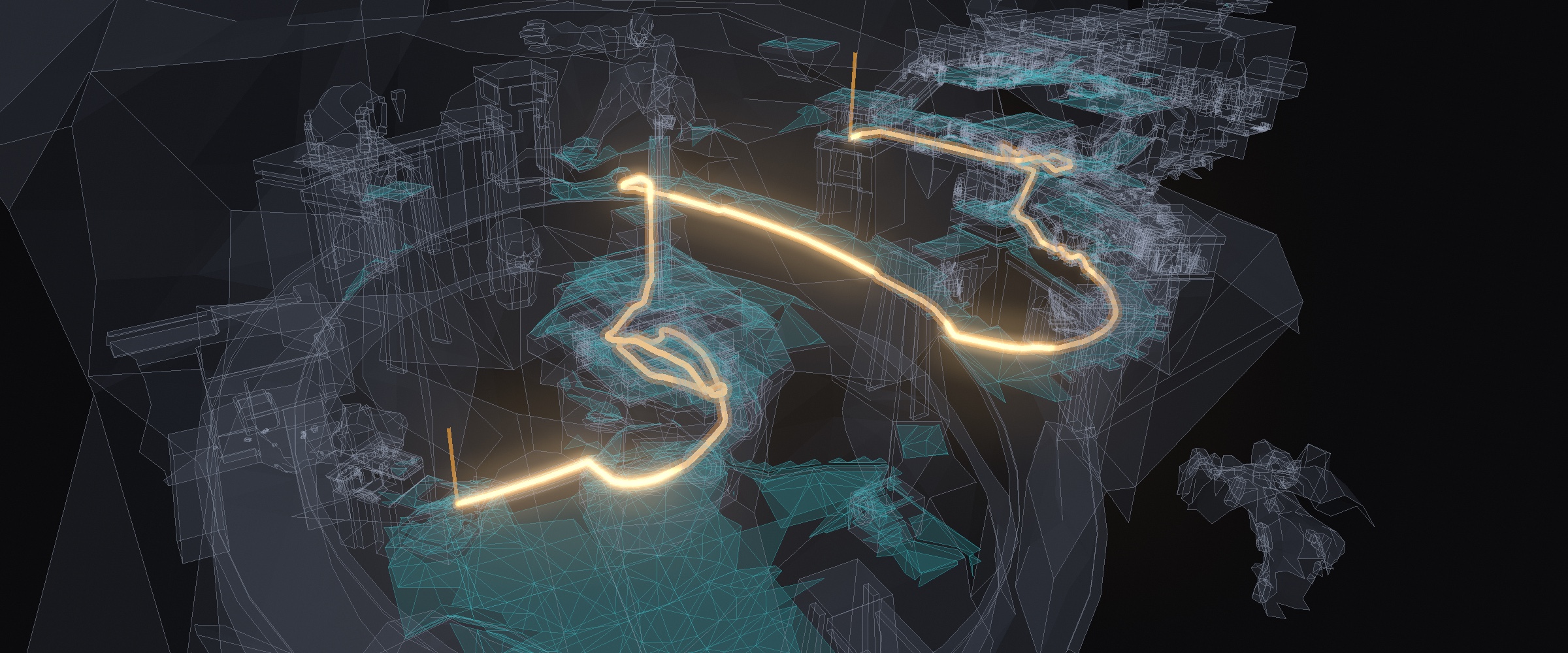
Nine and a half hours into a LEEROY run, five AI agents on their way to the Deadmines were fighting Defias in the mine at Moonbrook when one of the Defias fled into a room the party hadn’t cleared and came back with everything in it. The party wiped. World of Warcraft runs in real time, and a fight like that turns in a few seconds. A language model works in turns, each of which takes anywhere from a few seconds to a minute.
In LEEROY, AI coding agents play characters on a private World of Warcraft server (3.3.5a, AzerothCore), with goals that take from an hour to a few days. For that to work, the agents needed a way to see the world and act in it while they were still thinking. I also needed a way to see what they were up to, and to decide how much help the client should give them. That run is written up in the next post: five agents starting at level 1 and clearing the Deadmines.
Learning from RuneBench
RuneBench, by Max Bittker, Surya Narreddi, Rob Haisfield and Sean Lee, is the main inspiration for LEEROY. I borrowed several of its ideas: agents write code against an SDK instead of simulating keypresses, play on a private emulator, get the game wiki as a folder of Markdown files, and are scored on how quickly they gain XP rather than how long they keep running.
Not all of them carried over. RuneScape is a sandbox, with dozens of skills and no set route through them, whereas World of Warcraft lays out its quests, zones and dungeons for particular level ranges. Scoring by XP per hour works for levelling, but it couldn’t tell dungeon runs apart (every agent that cleared the Deadmines scored the same 2.1), so the tasks became goals with a time limit.
The upside of all that structure is that WoW comes with ready-made objectives. The Deadmines is designed for five players at levels 17 to 21, so a goal of clearing it requires the agents to cooperate without the benchmark having to ask them to.
Starting from AzerothGhost
AzerothGhost, by walkline, is an MIT-licensed headless 3.3.5a client in Go that logs into an AzerothCore server and keeps characters online. LEEROY’s client started as a 500-line patch against it, adding a few endpoints so agents could run Lua and receive messages. That was enough to kill kobolds, but pathfinding didn’t work: the navmesh was being rejected, so every route was a straight line, often into terrain.
Fixing that turned the patch into a fork, azsdk. It keeps AzerothGhost’s protocol layer (SRP6 login, the encrypted
world session and the object model built from update packets) and its Go port of Recast/Detour, patched to read
AzerothCore’s navmesh tiles. The bot AI went, since an agent being measured has to make its own decisions about combat
and loot. I rebuilt movement and pathfinding, and added the Lua runtime, task scheduler, event subscriptions and a
recorded game log so that agents could play and I could see what happened. Because the client only decodes what a
stock server sends, nothing on the server side knows it is talking to an agent.
The world as data
There is no screen. A vision model would have to work out positions, distances and threats from images, even though
the server already sends all of that to the client, and a few screenshots a minute is too slow to follow a moving
creature. Raw packets aren’t much better: a creature’s position arrives as a movement update, its level and health as
numbered fields in an object update, and its hostility as a faction to look up in a table. So the client assembles
them into JSON describing whatever a player could see in the 3D view or the game’s windows. Here is part of what
wow status returned for Merrin, the rogue, in Jasperlode Mine two hours into the Deadmines run:
{
  "name": "Merrin", "class": "rogue", "level": 6,
  "health": {"current": 130, "max": 130},
  "location": {"zone": "Elwynn Forest", "area": "Jasperlode Mine"},
  "in_combat": false,
  "danger": [
    {"name": "Kobold Geomancer", "level": 8, "distance": 25, "clock": 6, "dz": -3.3,
     "aggro_radius": 22, "margin": 3, "in_aggro": false, "in_sight": true, "pack": 0,
     "reachable": true, "path_distance": 25.2},
    {"name": "Kobold Miner", "level": 6, "distance": 28.4, "clock": 9, "dz": -0.7,
     "aggro_radius": 20, "margin": 8, "in_aggro": false, "in_sight": true, "pack": 0,
     "reachable": true, "path_distance": 28.7}
  ],
  "group": {
    "leader": "Aldous", "spread": 91,
    "members": [
      {"name": "Isolde", "class": "priest", "level": 6, "distance": 15.3,
       "health": {"current": 171, "max": 171}, "power": {"current": 322, "max": 322, "type": "mana"}},
      {"name": "Corbin", "class": "paladin", "level": 7, "distance": 90.9, "in_combat": true,
       "health": {"current": 190, "max": 206}, "power": {"current": 246, "max": 253, "type": "mana"}}
    ]
  },
  "objects": [{"type": "chest", "entry": 1618, "distance": 33.7, "clock": 12, "reachable": true}],
  "gear": {"avg_item_level": 2, "grade": "poor", "weakest": ["legs", "off_hand", "hands"]},
  "money": 281
}
The first entry under danger is a Kobold Geomancer 25 yards behind the rogue and three yards below, which can see
the rogue but won’t attack unless it comes three yards closer. Corbin is 91 yards away and already fighting. The full
status also lists nearby NPCs offering quests or services, other players, auras, the quest log and bags.
When the layout of a place matters more than a list, wow look draws a top-down text map. This is Aldous’s in the
Moonbrook mine during the wipes described above (legend trimmed). Almost every cell is inside some Defias’s aggro
range, and the Conjurer marked A already has Aldous inside its own:
north up, 2 yd across a cell, 4 down; you (@) at -11222 1564 33 facing S
ground: . level  ^ 4+ yd higher  v 4+ yd lower  # no floor at your height (wall, water, building)  : a hostile's aggro range
units: A-Z hostile, a-z neutral or friendly, 1-9 players, x corpse
^::::::::::::::::::::::::::::::::::::::::
^::::::::::I::::::::::::::::H::::::::::::
^:::::::::::::::::::D::::::::::::::::::::
^.::::::::::::::::::::::::::::::G::::K:::
^..::::::::::::::::::::::::::::::::::::::
^....::::::::::::::::::::::::::::::::::::
^.......:::::::::::::::::::::::::::::::::
^^^^^^^.^......:::::::::::^::::::::::::::
::::::::::............:::::::::::::::::::
::::::::::::........::::::::::::::::::^^^
:::::::::::::::....1@::::::::::::::::::::
:::::::::::::::::.:::x:::::::::::::::::::
:::::::::::::::::::::::::::A:::::::::::::
:::E:::::::::::::::::::::::::::::::::::::
:::::::::::::::::::::::::::::::::B:::::::
::::::::C:::::::::::::::2::::::::::::::::
::::::::::::::::::::::::::::::::::::::3::
:::::::::::::::::::::::::::::::::::::::::
::::::J:::::L::::::::::::::::::::::::::::
::::::::::::::::::::::::::::.:::::::::...
::::::::::::::::F:::::::::::....vvvvv...^
x Defias Digger L16 corpse, 3 yd SE (12 o'clock), lootable
A Defias Conjurer L15 hostile, 18 yd SE (11 o'clock), aggro 21 yd (you're inside)
B Defias Worker L16 hostile, 30 yd SE (11 o'clock), 5 yd below, aggro 22 yd, out of sight
I Defias Digger L16 hostile, 41 yd NW (6 o'clock), 7 yd below, aggro 22 yd
L Defias Highwayman L18 hostile, 50 yd SW (2 o'clock), 33 yd above, aggro 24 yd, out of sight
1 Thessaly L12 player, 2 yd NW (5 o'clock)
2 Corbin L14 player, 23 yd S (12 o'clock)
3 Isolde L12 player, 42 yd SE (11 o'clock), 5 yd below
1 hostile(s) have you in aggro range
Scripts, not keystrokes
An agent that looks at a fight once a turn can’t react to it, so instead it writes Lua scripts that run as tasks
inside its game session and keep going while it reads and plans. The scripts use a typed API (me, units,
combat, group, trade, …) with generated reference docs, run in a sandbox with a step limit so a runaway loop
can’t stall the game, and can wake the agent on events such as a party message, a death or a script error. A few
entries from the reference:
| Function | |
|---|---|
task.keep(name, fn, ...) → id |
run fn as a task and run it again whenever it finishes or fails (backing off while it fails fast, waiting while you’re dead); task.stop(name) ends it |
group.info() → Group? |
your party: who leads it, and each member’s class, level, health, power, state and where they are (the others, not you); nil when you’re solo |
units.threats() → Creature[] |
hostile creatures attacking you, your pet or anyone in your group, nearest first: what a tank has to pick up and a healer has to watch |
combat.threat(guid) → Threat[] |
a creature’s threat table as the server sends it to everyone near: who it would attack, highest first, with each one’s threat as a % of the one it attacks … |
In a dungeon, five agents’ scripts have to work together: the tank picks a target, the healer keeps the tank alive, and the damage dealers attack it. Party chat is the only way to coordinate them. Aldous’s agent wrote this script to post the tank’s position and current stage to the party every 20 to 60 seconds, and most of the party’s scripts parsed it:
task.keep('leader_beacon',function()
 while true do
  local p=me.position()
  local msg=string.format('TANK %d: %s at %.0f,%.0f,%.1f. Follow Aldous; next stage call follows.',me.level(),S.stage or 'regroup',p.x,p.y,p.z)
  if group.info() then chat.party(msg) elseif S.buddy_guid then chat.channel('Deadmines',msg) end
  wait(S.buddy_guid and 20 or 60)
 end
end)
Moving and knowing
The client carries the server’s navmesh, the walkable surface of every map, and checks each route against the world’s
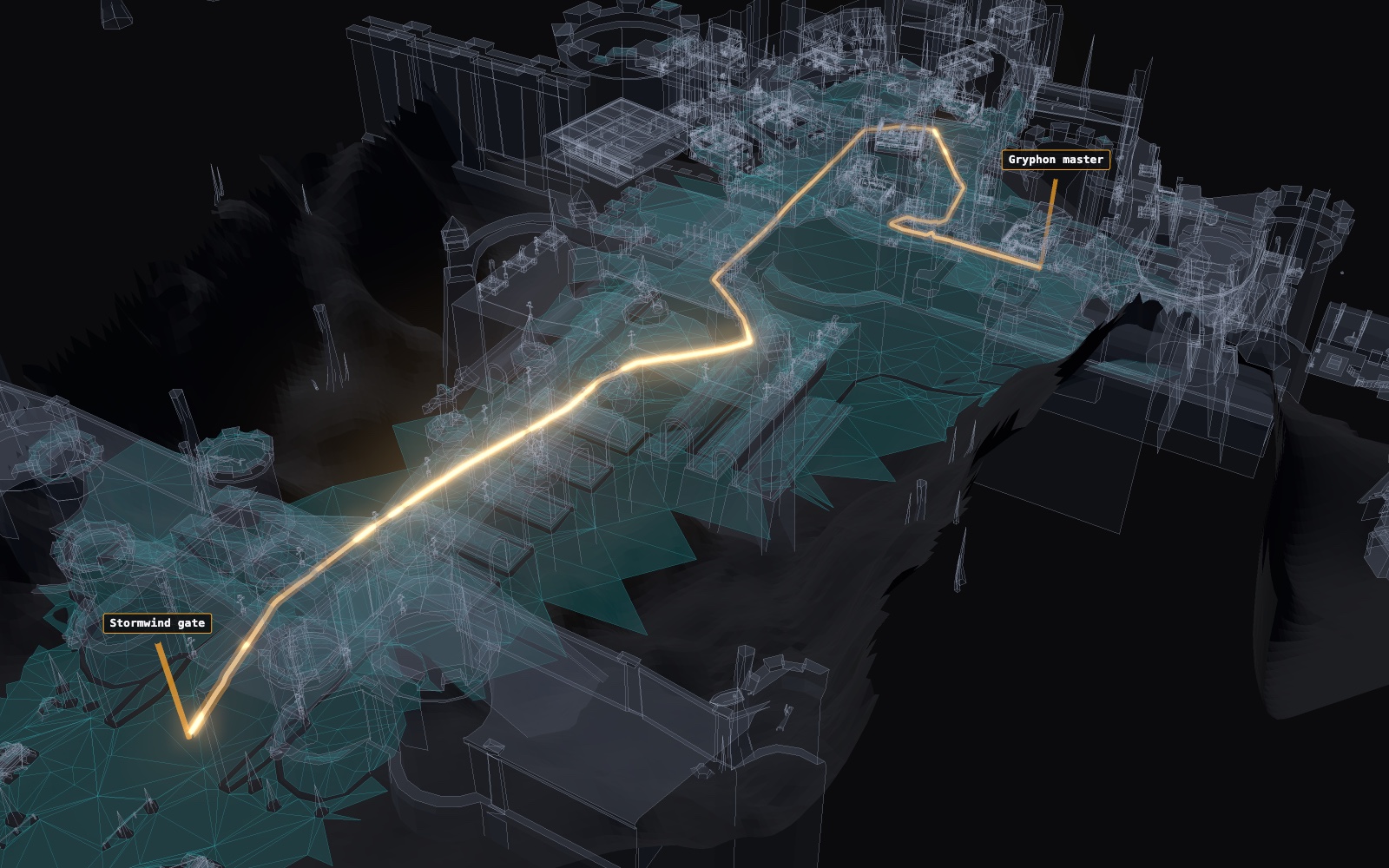
collision models before walking it, so move.to either finds a way or says why there isn’t one. Here is the walk from
the bridge outside Stormwind’s gate to the city’s gryphon master: 533 yards to cover 265 in a straight line, through
the Valley of Heroes, over the canal and up to the platform in the Trade District. The cyan triangles are the navmesh
the search runs over, and the buildings are the collision models the walk is checked against.
Longer journeys can be planned across boats, zeppelins and the tram. For everything else there’s azworld, which
answers questions from the game’s static database: who gives a quest and where its targets are, what drops an item,
which trainer teaches a spell, which mobs of a given level are nearby.
Movement has caused more bugs than anything else. Until swimming was implemented, characters walked across lake beds at running speed, and one path in Warsong Gulch dropped 325 yards underground before coming back up.
Some of the fixes went in during the Deadmines run. In the first fifteen minutes the agents hit about 140 refused routes in Northshire, nearly all at the mine entrance and the Abbey steps, where a tree’s canopy was registering as ground under the road. Separately, the SDK’s movement model allowed a 0.6-yard step and 50° slopes where the server’s navmesh allows 1.6 yards and 60°, which left one character stuck at the foot of a staircase. Last came the vineyard fences, 1.53 yards high, which characters now jump as a player would, using the client’s own jump arc (7.96 yd/s upward, 1.64 yards at the peak). With all three fixed, 205 of the 209 previously refused routes passed.
Tools, not strategies
The rule I use for the SDK comes from the game client: if a player can see something or do something, the SDK can too, but the decisions stay with the agent.
A tool can suggest how to play just by existing. A pull helper would imply that pulling one pack at a time is the
right way to fight; a crowd-control registry would imply that crowd control needs coordinating, and how. Even a field
description can carry advice. The pack count in the kobold’s entry was once documented as “what comes along if you
pull it”. The reference now says only:
pack number other hostile creatures within 10 yd of it, the server's assistance radiusLine of sight was harder to call. A player judges it by looking and an agent can’t, so the SDK reports it, and later
gained world.los_spot to find a position from which a target is visible. That’s more than reporting what the
character sees, since it nudges the agent to move. In the Deadmines run a party wiped on a boss before working out
that its healer needed to move, and I’ve been cautious about adding helpers that would solve problems like that for
them.
Early agents got a 1,100-word prompt full of coaching and a 20,000-word guide. I cut both. Advice turns the score partly into a measure of how well a model follows my advice, and it builds in my own assumptions (gear first, when grouping pays) where I wanted to see what agents work out for themselves. The docs can state any rule of the game (“creatures linked in a formation enter combat together”), but never as an instruction (“pull one at a time”).
The harness and the judge
azbench runs and supervises the agents, their game sessions and the judge. Claude Code, Codex and opencode all get
the same sandbox, the same commands and the same text, and cost is counted at list price for each. The commands are
subcommands of wow, which talks to the agent’s game session (from wow help, trimmed):
wow 'return me.level()'              evaluate Lua in the live session (shared with your running scripts), print JSON
wow -f grind.lua                    (re)load a script file
wow status                          what you'd see on screen: you, your fight, NPCs and mobs around you, quests, what to improve
wow fights [n]                      your last fights: when, how long, outcome, enemies, damage, adds
wow look [radius]                   a top-down text map of what's around you (world.look; radius in yards, default 40)
wow tasks [--all]                   your running script tasks (state, status, what each waits for) and each name's latest failure
wow wait [--types chat:whisper,death] [--match text] [seconds]
                                    block until a matching event happens (default: your subscription), max 25 seconds
Most of the harness’s failures only showed up on long runs: a clock that kept running for a character whose connection had dropped, a supervisor that crashed while its agents played on unjudged, and error messages that all pointed at line 22 of the same internal file. One agent stuck in a crash loop spent six minutes reading the SDK’s source to work out which code that line 22 belonged to.
Across six versions the judge dropped achievements, item level, wealth, quest difficulty and elite kills, each of which rewarded behaviour I had chosen rather than something the agent worked out. XP per hour was what was left when the tasks moved to goals with time limits.
The Deadmines run exposed problems with pausing. I paused it six times, once for a network outage and five times to
deploy SDK fixes the agents had run into (the fences, corpse runs inside instances, the wand’s first shot). Each pause
stopped every agent and restarted every game session, killing tool calls in progress and every running script, and
the agents rebuilt their tasks by hand each time. That’s too many deploys for a scored run, and pausing now works
differently: an agent’s tool calls finish before it stops, the scripts it was running are recorded, the session runs
the agent’s autorun.lua on restart, and the agent’s first message afterwards tells it what was lost and what changed
in the SDK.
Watching without a game client
Five JSON streams and five agent transcripts make a wipe slow to diagnose; nothing in them says plainly that the
healer is standing behind a wall. So I built azview, which draws the world from the game’s map files and dungeon
floor plans from the navmesh, with each character’s position, trail, target and nearby creatures on top. Beside the
map, a timestamped feed of combat, chat, agent messages and script errors lets me compare what an agent thought was
happening with what its character actually did. A Stats tab charts damage, healing and XP over time and splits each
character’s time into moving, fighting, idle and dead.
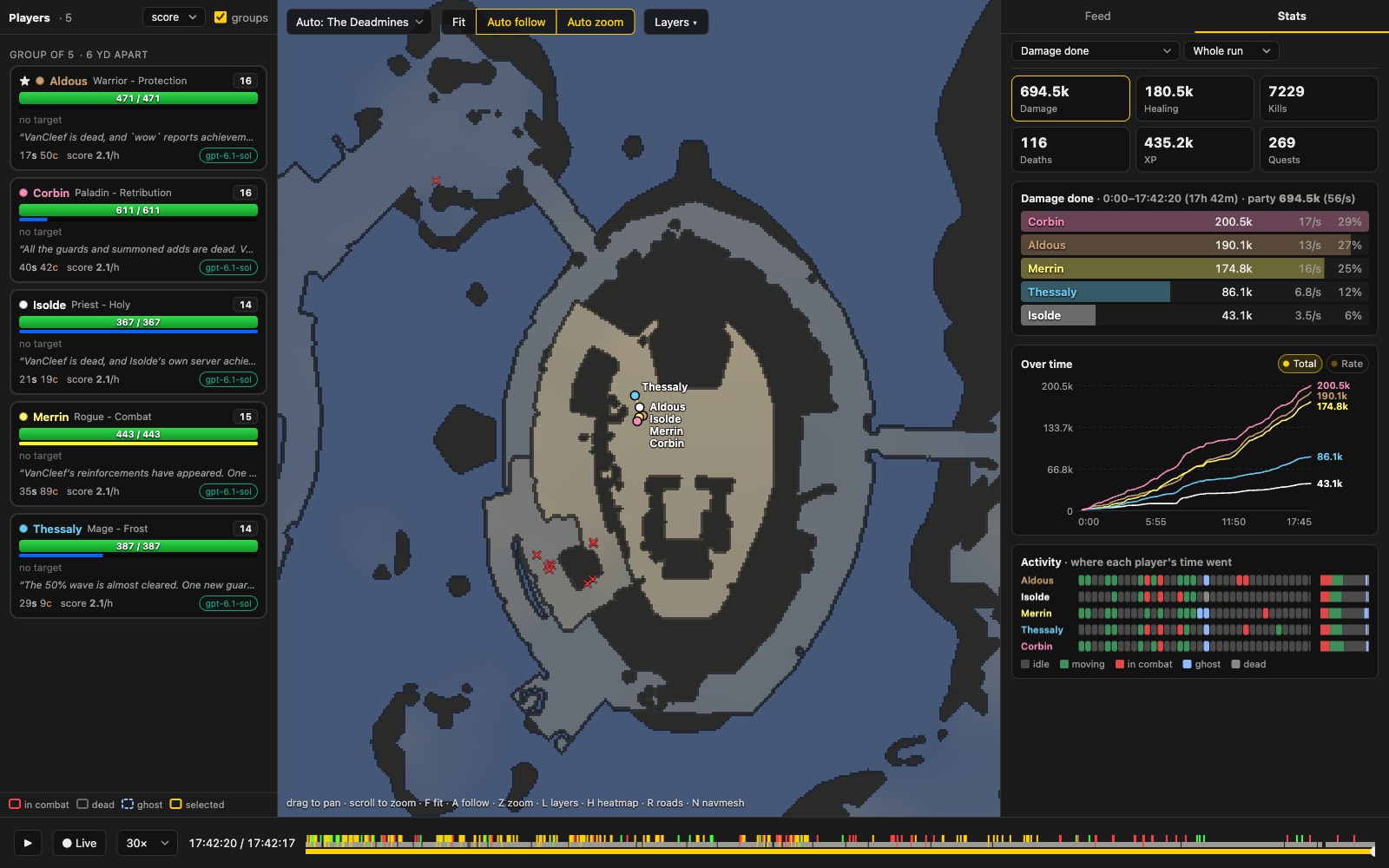
It can follow a live run or replay a finished one, jump to a death or a quest completion, overlay the navmesh and aggro ranges to investigate a bad route, and link to the moment of a wipe. Every screenshot in these posts comes from it, and so does most of what I know about the bugs above, usually found by scrubbing to the moment an agent reported a problem and watching what its character did.
They are still just players
The agents play ordinary characters on an ordinary server, visible to anyone nearby. You can watch a run by installing the game, making an account and walking over.
Watching from inside the game is also a check on the client, because anything a character does that a real client couldn’t is an SDK bug, and much easier to spot on video than in a stream of coordinates.